
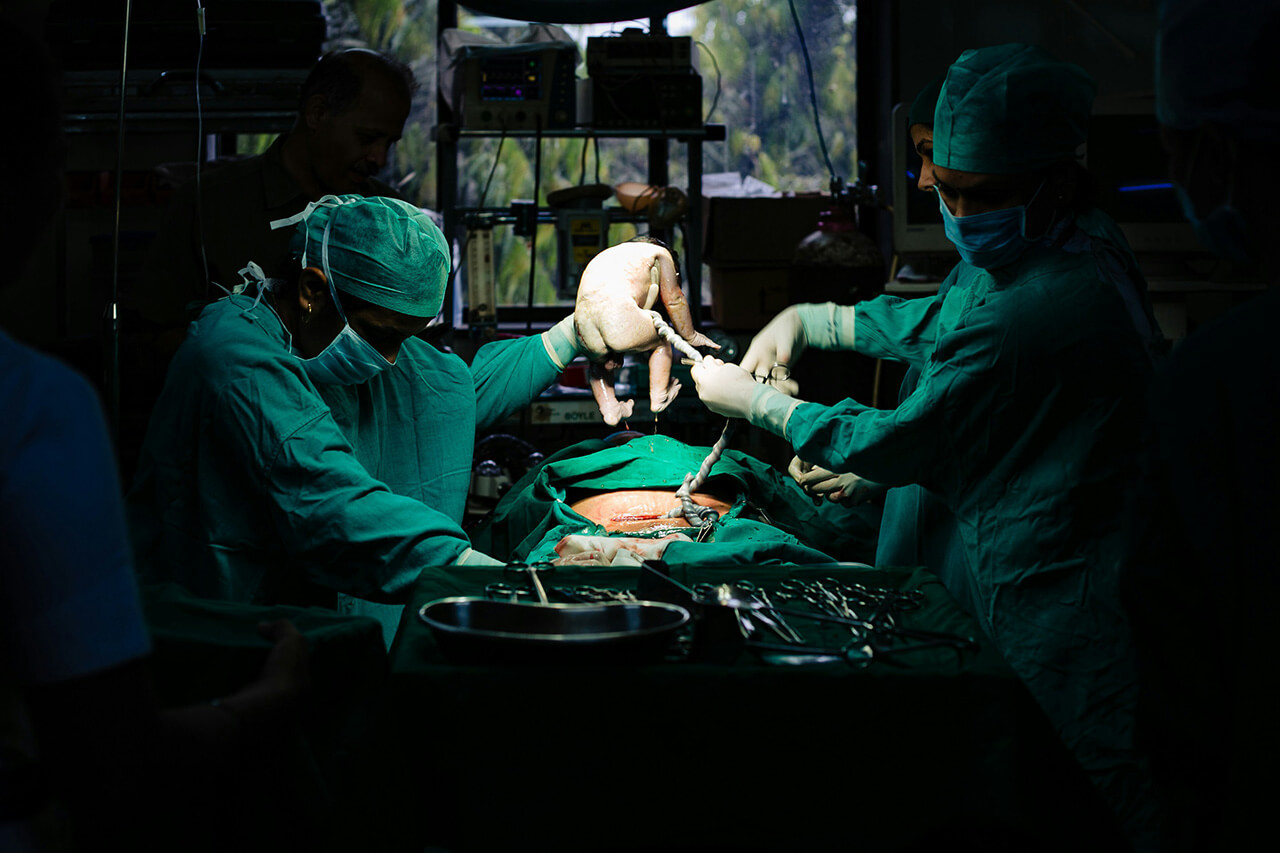
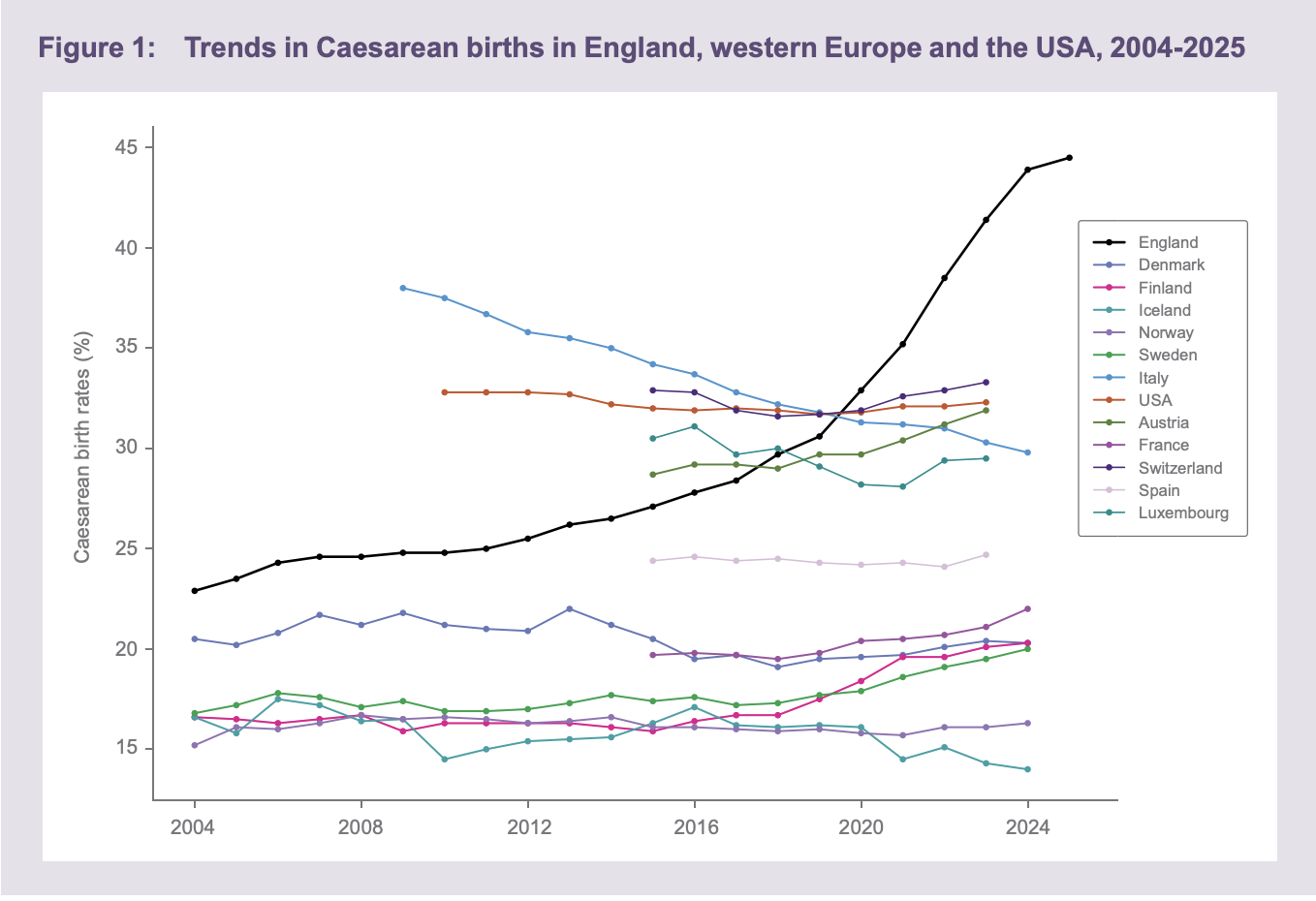
The NPEU report ‘International comparison of caesarean birth rates, 2020 – 2025’, published on 5th June 2026, describes a marked increase in the caesarean birth (CB) rate in England in the last 5 to 7 years, much greater than other comparable countries.
The graph speaks for itself:
A thoughtful BBC news article by Catherine Burns, BBC health correspondent, and Maryam Ahmed, BBC Verify, analysed this data and reflected on some of the reasons for the increase, also covered in a discussion on Radio 4 Woman’s Hour.
Although the article acknowledged the increase in CB has not been accompanied by improvements in outcomes for babies – as you would expect if the CBs were protective of babies’ wellbeing – it did not explore the international data further to show how high UK CB rates are associated with worse outcomes for babies, compared to other countries. Many of the countries with the lowest CB rates also have the lowest neonatal mortality rates – for example, Iceland (CB rate 14%), Norway (CB 16.3%), Sweden (CB 20%), Finland (CB 20.3%), Estonia (CB 20.7%), Slovenia (CB 21.5%) and Latvia (CB 24%) all have neonatal mortality rates at approximately 1/1,000 compared to 3/1,000 in the UK (England CB rate 44.5%). (And by the way, Latvia has approximately the same incidence of diabetes as the UK, according to Diabetes Atlas.)
What was also missing from this analysis, was reference to the 20% increase in the overall rate of maternal death in the last 13 years in the UK (MBRACCE Maternal mortality 2022-2024). Nor was there any reference to the risks of CB.
When will anybody dare to suggest that this unprecedented increase in maternity mortality might possibly be associated with a rapid increase in CB rates?
The increased maternal mortality rate for Black and Asian women, is also associated with an increased CB rate – close to 1 in 3 unplanned ‘CB rate for Black women compared to 1 in 4 overall.
The Royal College of Obstetricians & Gynaecologist (RCOG), in its information for parents ‘Considering a caesarean birth‘ acknowledges:
There are risks for both you and your baby if you have a planned caesarean birth and it may take longer to recover after your baby is born. Having a caesarean birth is a major operation with risks that should be compared with your risks of a planned vaginal birth.
It states the increased risk of maternal death as 6.25 times higher than for vaginal birth (including instrumental vaginal birth). This is a very rare event – approximately 65 maternal deaths for the 260,500 Caesarean births in England & Wales in 2025 – but it is important for all those involved to be aware of the increased risk.
The possibility of a causal link deserves urgent investigation, and the raw facts need to be more widely known.
Or is this just something too horrible to contemplate?
Equally, the increasing CB rate might be associated with the lack of maternal satisfaction & levels of trauma increasingly reported – for some at least, while recognising that trauma and harm is also related to CB being withheld or delayed when requested or needed.
So despite a general assumption that CB is safer, for mother and baby – the national data indicates that during this period of rapidly increasing CB rate there have been no improvements in outcomes for babies (and worse outcomes than in many countries with lower CB rates) and an increase in maternal death rates, dissatisfaction and traumatic birth experiences. Is this of any concern to those in positions of influence?
On Woman’s Hour, Dr Alison Wright, President of the Royal College of Obstetrics & Gynaecology (RCOG) and consultant obstetrician, raised concerns about inadequate funding and resources with increasing rates of surgery, and voiced a need to understand the data better – but did not raise any concern about the increased incidence of CB in itself. Professor Helen Cheyne, midwife and Professor of Maternal and Child Health Research, also voiced no concern in response to the data, replying to her own question, “Is it a good thing, is it a bad thing? We need more data to find that out”.
(Both Helen and Alison are members of the National Maternity and Neonatal Taskforce which will oversee improvements to maternity and neonatal care following the Amos review.)
Professor Shakila Thangaratinum, Professor of Women’s Health and consultant obstetrician told the BBC:
“An increase in emergency caesarean sections poses concerns if these are not accompanied by a corresponding decrease in stillbirths, newborn and maternal complications.”
These concerns need to be stated more explicitly for the public, clinicians and policy makers to appreciate the potential harm that may be being caused. There is a risk that some caesareans are being done unnecessarily, causing harm to some families, without any of the expected improvements in outcomes. The BBC article hints at these problems, but doesn’t make them explicit enough. Somebody needs to say these things out loud.
The article and programme consider the possible reasons for this increase.
Catherine refers to the idea that the increase is often attributed to women giving birth now who are older, heavier and more likely to have underlying health problems – and sensibly points out that this has been happening for years, and changing very slowly, so cannot account for the whole increase. The same demographic changes are also happening in other countries which are not experiencing such rapidly rising CB rates. And other changes in population health – reduction in smoking in pregnancy, less teenage pregnancies, better management of diabetes, increased height – should have resulted in less complications and lower CB rates.
She suggests that rising CB rates may result from a culture of fear, which has arisen from recent maternity scandals with a repeated theme of a harmful reluctance to perform CB when needed or requested. She quotes Marian Knight, director of NPEU:
“NHS staff and mothers may also be influenced by high profile maternity scandals … Legal cases typically question why caesareans are not undertaken or not undertaken sooner. Doctors and midwives are rarely criticised for performing an early caesarean … We also need to recognise the potential impact of rising fear among women, families and staff, which may lead more to choose or to recommend CB.”
The international data, and these comments about the culture of maternity services, indicate that there may be a bias in the UK in favour of intervention, when it is not necessary for a safe outcome.
It would be so tragically ironic, if maternity investigations intended to reduce harm for women and birthing families, have actually resulted in more fear and anxiety amongst families and staff, leading to more complications (eg recent increase in low birthweight and pre-term birth rates in England & Wales) and then more interventions, without any improvements in outcomes.
It has been stated that the reasons for the increase in CB are not known, and more clinical information about the indications for CB is certainly vitally important – but there are some reasons that have been clearly evidenced for many years and are largely absent from the conversation: the way maternity care is organised has an impact on clinical outcomes.
Midwifery Continuity of Care (MCoC) has been shown to reduce caesarean and instrumental births. Midwife-led units reduce CB and instrumental birth and a US comparison of midwifery and obstetric-led demonstrated the same. We already know these models of care improve clinical outcomes and result in more positive experiences – we do not need more information to understand that a commitment to implementing them will result in lower rates of interventions, safe outcomes and improved experiences of birth.
It is time to make a more explicit challenge to the narrative that CB makes birth safer, and any reluctance to perform CB is dangerous. And to acknowledge that increased interventions, at higher cost to the NHS, without evidence of benefit and increased risk of harm should be regarded as something of concern to all. At the same time, the principles of bodily autonomy, the ‘right to choose’ and the utmost importance of listening to and respecting women and birthing people must be upheld to ensure safe and positive birth experiences.
I was reflecting on these shocking statistics recently. One thing I’d like to see change is the use of the terminology ‘caesarean birth’ CB. Let’s be real – it’s surgery, let’s not kid ourselves and women. There is no doubt in my mind that the instigation of changes in language create changes in behaviour and culture. We have downgraded this major abdominal surgery to just another form of ‘birth’ – it is not – it is a serious intervention that can be lifesaving, but only with judicious use. Currently fear leads the system and unfortunately, women’s views on birth.