

New Freedom of Information research from the Association of Radical Midwives and Fund Future Midwives UK campaign reveals one predicted NQM job for every 3.6 final-year midwifery students, and the jobs that do exist are increasingly part-time and precarious.
By Gillian Meldrum · ARM Steering Group, supporting Fund Future Midwives UK
The story we keep hearing about midwifery is one of crisis: services dangerously understaffed, midwives leaving, women and birthing people receiving care from a workforce stretched past breaking point. So why, at the end of three years of training, are so many newly qualified midwives, the very people the NHS desperately needs, finding there are no jobs for them to interview for?
I wanted to know how bad the gap really is, and whether the picture being painted in the press matched what was happening on the ground throughout the country. So on behalf of ARM, and in support of the Fund Future Midwives UK, I submitted Freedom of Information requests to NHS trusts and health boards across England and Wales.
We now have responses from 60 organisations, covering 1,586 final-year student midwives due to qualify in summer 2026, more than half of the estimated English cohort.
What the responses show, I’m afraid, is a workforce planning failure hiding in plain sight.
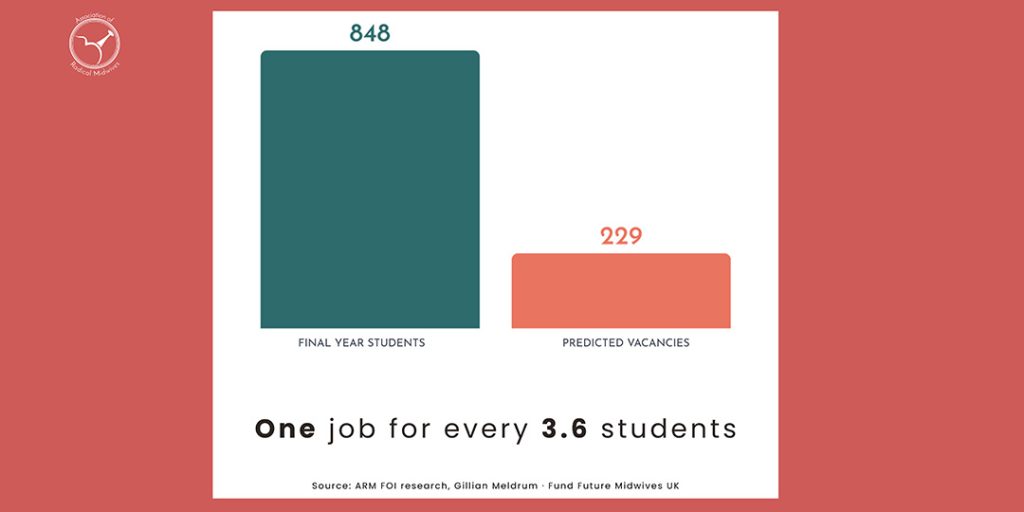
The headline gap
Of the 60 trusts that responded, 25 told us they were unable to predict how many newly qualified midwife (NQM) posts they expected to have available between September and December 2026. The 35 trusts that could give us a number reported a combined 848 final-year students placed with them and just 229.22 predicted vacancies between them.
That works out at one predicted NQM job for every 3.6 students. A vacancy rate equivalent to 27% of student numbers. Two trusts, Gateshead and Morecambe Bay, reported predicted vacancies equal to or greater than their student numbers, but they are very much the exceptions.
For most students, the picture is one of deep uncertainty about whether the job they have trained for will actually exist when they qualify.
What happened last year is no comfort
Because so many trusts couldn’t provide any information on predicted future vacancies, we also asked what they had actually recruited to since September 2025. This seemed a reasonable proxy for what students entering the jobs market this summer might expect, if the provisions of the ‘Graduate Guarantee’ of last year are replicated.
Fifty-nine trusts (covering 1,559 students) gave us this information. Between them, they recruited 1,118.7 NQMs since September 2025, equivalent to 72% of the current final year intake.
In other words: even with the ‘Graduate Guarantee’ in place, more than one in four newly qualified midwives did not find an NHS post in the trust where they trained (reflecting similar findings to the RCM Survey). The predicted picture for this autumn looks worse, not better.

Photo by Max Tcvetkov on Unsplash
And the jobs that do exist are increasingly precarious
The numbers above only tell half the story. The jobs being offered are not the jobs students are training for.
- 29% of the NQM posts recruited last year were short-term contracts. Twenty-nine percent of trusts offered at least some short-term posts, and in 9 trusts at least half of all NQM recruitment was on short-term terms.
- Two trusts told us all of their NQMs had been placed on fixed one-year contracts, including one trust where every final-year student was offered a contract, but only for twelve months.
- Of the 55 trusts able to break recruitment down by hours, 60% of the posts were part-time. Nine trusts recruited exclusively to part-time posts.
So a student midwife graduating in 2026 has, on the available evidence, roughly a one-in-three chance of finding no NQM post at all in the trust where they trained, and if they do find one, the most likely offer is a part-time post, with a good chance it will be on a short-term contract.
What Baroness Meron has now accepted
For all the Government’s reassurances about workforce planning, ministers themselves have now acknowledged the gap. In the House of Lords on 21 April this year, the Minister for Women’s Health and Mental Health Baroness Merron accepted that 31% of newly qualified midwives “do not have a job or are on fixed-term contracts,” and that “this needs sorting out.” She also confirmed that the so-called “Graduate Guarantee’ scheme, backed by £8 million, has so far created 850 time-limited or temporary roles, expressly designed, in her words, to bring people in “under existing budgets.” £8 million would only directly fund a maximum of 208 entry level Band 5 posts, so the other posts have been created by converting vacant MSW roles into Band 5 posts.
Her preferred framing is that this is “more a misalignment of numbers than a straightforward shortage.”
I would gently suggest that 848 students placed with trusts that have predicted just 229 vacancies between them is not a misalignment that can be addressed with temporary contracts, however well-intentioned. It is the predictable consequence of a system in which trusts and universities negotiate clinical placements three to four years in advance, but no equivalent planning takes place for the substantive jobs those students will need at the end of their training.
It is also a system in which the Government does not collect the data needed to see the gap. In June 2025, the Government confirmed it does not hold information on the number of midwives graduating in England or Wales, or on how many of them go on to secure NHS employment. UCAS acceptance figures were cited instead, but acceptance is not graduation, and graduation is not employment.
This research is one of the very few sources of trust-level evidence on what is actually happening to newly qualified midwives in 2026. We collected it ourselves because no one else was.
The cost is borne by students, the midwifery workforce and parents & families
While ministers debate alignment and trusts review their workforce models, final-year students are completing demanding clinical placements and writing dissertations under the additional weight of not knowing whether they will have a job in September. Some are already considering leaving the course. Others will qualify and accept whatever is on offer, including hours and contracts that don’t sustain a career, because the alternative is no NHS post at all. And it is not only students who pay. Maternity services are chronically understaffed, and the qualified midwives already working need these newly qualified colleagues to come in, not lost to the profession or shunted into part-time and short-term posts.
What needs to happen
ARM has been in correspondence with the Royal College of Midwives about these issues over recent months, and we are grateful for the constructive dialogue. As Gill Walton, RCM Chief Executive, put it in April: “These figures show that this is more than a simple ‘misalignment’, it’s a system crying out for more staff, and one that is turning its back on the very professionals it has educated and supported to join the workforce… This is about more than jobs — it’s about the future of safe, sustainable maternity care.”
The Association of Radical Midwives alongside Fund Future Midwives UK is calling for:
- A guaranteed substantive Band 5 post for every newly qualified midwife within six months of graduation, on full-time hours as the default and free of short-term contracts, not a time-limited “graduate guarantee” role created by re-banding existing posts to fit existing budgets.
- Multi-year, recurrent funding linked to graduate numbers, in place of the current one-off £8 million allocation.
- Removal of tuition fees for midwifery degrees in England, bringing England into line with Wales, Scotland and Northern Ireland, together with a fair bursary, an end to 2,300+ hours of unpaid clinical placement, and tuition fee reimbursement for midwives who qualified after the 2017 bursary removal.
- Comprehensive workforce planning with proper alignment between universities and trusts, and a national data infrastructure that tracks the journey from acceptance, to graduation, to NHS employment, so the next “misalignment” cannot happen.
If you trained as a midwife to give women and birthing people the care they deserve, you should be able to smoothly transition into a job that lets you do it without £60,000 of debt and a one-year contract waiting on the other side. That, surely, is not too much to ask.
How you can help
- Write to your MP. Adapt our template letter available at midwifery.org.uk/get-involved/campaign and let us know if you receive a reply at campaigns@midwifery.org.uk.
- Connect with Fund Future Midwives to join their protests & sign their petition
- Share this research with colleagues, students, and anyone in your local maternity service.
- Tell us your story. If you are a final-year student worried about jobs, a newly qualified midwife on a short-term contract, or a midwife watching colleagues leave for lack of substantive posts, we want to hear from you: campaigns@midwifery.org.uk.
About this research
These findings come from Freedom of Information requests submitted by ARM steering group member Gillian Meldrum to NHS trusts and health boards across England and Wales, in support of the Fund Future Midwives UK campaign. Requests were sent from 27th March 2026 and we are still receiving replies. We asked for information on:
- the number of student midwives in their final year of placement;
- predicted vacancies for newly qualified midwife posts between September and December 2026;
- actual NQM recruitment since September 2025, including the number of full-time, part-time, and short-term contract posts offered.
Sixty trusts and health boards have responded so far, covering 1,586 final-year student midwives, more than half of the estimated English cohort. Twenty-five of those organisations were unable to provide predicted vacancy figures, citing uncertainty about future workforce numbers. The 35 organisations that did report predicted vacancies form the basis for the headline figure of one NQM job for every 3.6 students.
Underlying data and trust-level responses are available on request, please email campaigns@midwifery.org.uk.
The Royal College of Midwives estimates there are around 3,250 final-year student midwives across the UK, of which approximately 2,750 are in England.
Quotes from Health Minister Baroness Merron are taken from the House of Lords debate on the graduate guarantee for newly qualified midwives, 21 April 2026 (Hansard, vol. — col. 605–608).
———
Gillian Meldrum is a retired midwife and a member of the ARM Steering Group. She is a regular contributor to Midwifery Matters.
The Fund Future Midwives UK campaign is supported by the Association of Radical Midwives.
If this matters to you: www.midwifery.org.uk/join-us/
0 Comments