
Surviving childbirth is not the same as experiencing respectful, equitable, and empowering reproductive healthcare.
After years of working in midwifery education, community health, and research in Indonesia, I have increasingly questioned whether our understanding of maternal healthcare is broad enough to reflect women’s actual experiences. Across the Indonesian archipelago, midwives are often the first point of contact for women seeking reproductive and maternal healthcare. They work in public health centers, villages, hospitals, and community settings, navigating clinical responsibilities alongside social expectations, cultural traditions, economic inequalities, and systemic limitations.
Yet not every woman experiences the healthcare system in the same way.
An adolescent who becomes pregnant may fear judgment from healthcare providers and rejection from her community. A woman living with HIV may worry about breaches of confidentiality or discrimination when accessing reproductive healthcare. A survivor of gender-based violence may need emotional safety and trust before she can speak openly about her health. For women in economically disadvantaged or geographically underserved communities, transportation costs, limited facilities, and fragmented referral systems can make even routine healthcare difficult to access.
Healthcare access is not simply about whether a service exists. It is also about whether women feel safe, respected, included, and able to make decisions about their own bodies.
Midwives cannot fix a broken system alone
Midwives are expected to provide clinically competent, evidence-based, and timely care. They must recognize complications, manage emergencies within their competencies, and ensure appropriate referrals. However, the realities of midwifery practice extend far beyond clinical procedures.
My experience in midwifery education has strengthened my conviction that future midwives need more than technical knowledge. They must also learn to listen without judgment, communicate across cultural differences, recognize the effects of trauma, and understand the social circumstances shaping women’s health.
This is particularly important when caring for adolescents and other vulnerable populations. A technically correct intervention may still fail if a woman feels stigmatized, excluded, or unable to participate in decisions about her care.
The challenge is not to choose between clinical excellence and compassionate care. Both must become integral to professional midwifery.
It also requires us to reconsider how we educate future midwives. Whose needs are prioritized in our clinical guidelines? Are students prepared to address maternal mental health, gender-based violence, HIV-related stigma, and reproductive health inequalities? Do they understand how poverty, geography, and cultural expectations influence healthcare decisions?
These are not optional topics to be added to an already crowded curriculum. They are fundamental competencies for a profession that works so closely with women, families, and communities.
However, we cannot continue asking midwives to deliver equitable care while leaving them in under-resourced facilities, providing insufficient professional support, and expecting them to navigate complex social and cultural challenges without adequate preparation.
Equity cannot depend on the goodwill of individual midwives alone. It requires institutional responsibility and a health system willing to address its own inequalities.
What communities can teach health systems: The experience of SEKOCI
My commitment to community-based maternal healthcare has also shaped the development of Sekolah Komplementer Cinta Ibu (SEKOCI), an initiative I founded to complement maternal education and support in Indonesia.
SEKOCI emerged from a simple understanding: pregnancy and early parenthood involve much more than physical changes. Women and families also need emotional reassurance, practical knowledge, social connection, and opportunities to discuss their concerns in a supportive environment.
The program integrates maternal education, psychosocial support, and evidence-informed complementary approaches, including prenatal gentle yoga, maternal and infant massage, relaxation techniques, and nutritional guidance. It also promotes collaboration among academia, healthcare providers, government, communities, and other stakeholders through a pentahelix approach.
During the COVID-19 pandemic, e-SEKOCI extended this model through digital platforms such as WhatsApp, Zoom, Instagram, and YouTube. This experience demonstrated how accessible digital communication could help maintain maternal education and support when face-to-face interaction became difficult.
For me, the significance of SEKOCI lies not simply in the activities it offers, but in its approach to healthcare. It creates opportunities to connect professional knowledge with community needs and recognizes women as active participants in their own care. However, community-based innovation should not be romanticized as a substitute for a functioning health system. Local initiatives need evidence, sustainable partnerships, and integration with formal healthcare services. Their potential lies in complementing professional care, strengthening continuity, and making healthcare more responsive to the realities of communities.
The lesson is that health systems should not simply deliver interventions to communities. They should also learn from the communities they serve.
Digital health is not automatically inclusive
My research also explores adolescent reproductive health and digital approaches to HIV education and prevention. These areas have reinforced another important lesson: innovation is valuable only when it addresses the barriers people actually face.
Digital health tools can expand access to information, support confidential learning, and connect people with healthcare services. For adolescents, in particular, digital platforms may offer opportunities to access reproductive health information in ways that feel more private and accessible.
Yet technology alone cannot eliminate stigma, guarantee confidentiality, or resolve weaknesses in service delivery.
For adolescents and other vulnerable populations, digital interventions must be designed with privacy, accessibility, health literacy, and trust in mind. They must also connect users to appropriate and reliable healthcare services.
The same principle applies to maternal health. Whether through digital education, community programs, or formal clinical services, innovation should begin with the people it intends to serve, rather than simply with the technology available.
We need to move beyond asking whether a digital intervention works and ask another question: Does it actually reach those who need it most?
Rethinking the future of midwifery: Beyond numbers and targets
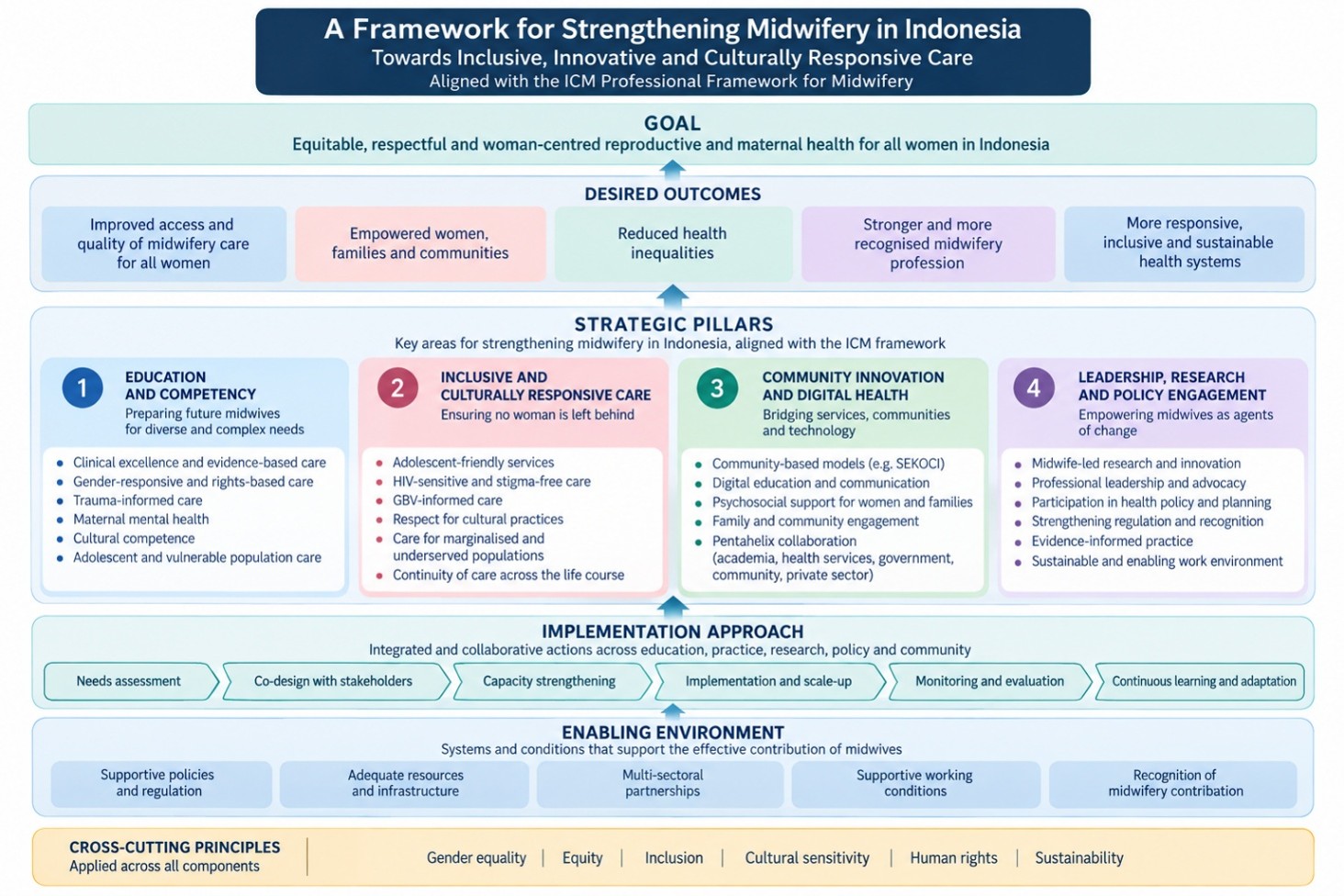
The International Confederation of Midwives (ICM) Professional Framework for Midwifery offers an important perspective for understanding these challenges. Midwifery philosophy and essential competencies cannot operate in isolation from education, research, regulation, professional leadership, continuity of care, and an enabling working environment. Gender equality, justice, equity, diversity, and inclusion must underpin the entire professional system.
This interconnected perspective is particularly relevant in Indonesia, where geographical diversity, unequal resources, and local cultural practices shape how healthcare is delivered.
Policymakers and educational institutions must therefore look beyond increasing the number of midwives. They must invest in competency-based education, strengthen midwife-led research, support community-based models of care, and establish working environments that allow midwives to practice safely and effectively.
Three priorities deserve particular attention.
First, midwifery education must better integrate gender-responsive care, trauma-informed approaches, maternal mental health, cultural sensitivity, and reproductive rights into professional competencies.
Second, community-based innovations need stronger institutional recognition and sustainable support. Initiatives such as SEKOCI demonstrate the value of connecting healthcare institutions with local communities, but their long-term contribution depends on evidence, collaboration, and integration into broader health systems.
Third, midwives must be recognized as contributors to health policy, research, and system transformation, rather than being viewed solely as frontline service providers. Their experiences provide valuable insights into barriers that may remain invisible in national statistics and policy documents.
Ultimately, a safe birth will always be essential. But the future of midwifery cannot be defined by birth outcomes alone. It must also recognize the conditions that allow women to access care before pregnancy, throughout childbirth, and long after they become mothers.
For me, rethinking midwifery means building a profession that combines scientific evidence with empathy, clinical competence with social awareness, and professional standards with cultural sensitivity.
It also means being willing to question the systems we work within, acknowledge whose voices remain unheard, and recognize that healthcare equity requires more than good intentions.
Perhaps the most important question is no longer simply how many women our health systems reach, but who continues to be left behind, and what we are prepared to change to ensure that no woman is excluded.
That is where the future of midwifery and reproductive healthcare in Indonesia must begin.
Rizka’s full article will be featured in our upcoming Midwifery Matters magazine.

about the author
Rizka Ayu Setyani is a lecturer in Faculty of Medicine, Universitas Sebelas Maret, Indonesia. She discusses how the application of the ICM Framework for Midwifery to local practice can improve outcomes and advance justice, dignity and health equality.
0 Comments